
Aquapets ( KowloonAquarium)
Tonina Fluviatilis
Tonina Fluviatilis
Couldn't load pickup availability
Botanical Overview & Taxonomy
Natural Habitat & Distribution
-
Native Range: Southern Mexico, Central America, and Northern South America (Colombia, Venezuela, Peru, Brazil, Guianas), including Cuba and Trinidad .
-
Environment: Found in shallow, slow-moving blackwater rivers, rivulets, and savanna swamps. It often forms dense, floating mats in water with very low mineral content .
Physical Description
-
Growth Form: Erect, slender stems (20–50 cm tall, sometimes up to 100 cm). It has a distinctively stiff, upright growth habit .
-
Leaves: Small, sessile, lanceolate-linear (approx. 1-2 cm long). Leaves are arranged densely along the stem (polystichous) and often have a slight recurve (curve backward) at the tip .
-
Inflorescence: Produces small, globular, white to brownish head-like clusters (capitula) on short peduncles (stems) in nature, resembling tiny sea urchins. It rarely flowers under submerged aquarium cultivation .
Aquarium Care & Cultivation (The "Hard-to-Grow" Aspect)
It is widely described as a high-difficulty plant unsuitable for beginners. It requires a "high-tech" setup .
1. Water Chemistry (Non-Negotiable)
-
pH: Strictly acidic (5.0 – 6.6). It deteriorates rapidly in neutral or alkaline water .
-
Hardness: Requires very soft water (KH 0-4, GH 3-8). It does not tolerate carbonates or hard water .
-
Temperature: Tropical (22°C – 30°C / 72°F – 86°F). Do not drop below 18°C .
2. Lighting & CO2
-
Light: High (approx. 1 watt per liter or more). Inadequate light causes etiolation (stretching) and lower leaf loss .
-
CO2: Mandatory injection (20-40mg/l). It is a heavy CO2 user; supplementation is required for dense, compact growth .
3. Substrate & Fertilization
-
Substrate: Not a heavy root feeder, but benefits from nutrient-rich, acidic-acting soil. Avoid calcium-leaching substrates (like coral sand or certain gravels) .
-
Fertilization: Water column dosing is essential. It requires balanced NPK, Iron, and micronutrients. Despite needing nutrients, it is not a "greedy" feeder compared to Rotala or Ludwigia; light, consistent dosing is best .
Propagation
-
Method: Vegetatively via cuttings (lateral shoots or trimmed tops) .
-
Technique: Use shoot tips about 3-5 cm long. Replanting very long stems often results in a "ratty" appearance with fuzzy aerial roots before they adapt .
Aquascaping Uses
Materials
Materials
Shipping & Returns
Shipping & Returns
Dimensions
Dimensions
Care Instructions
Care Instructions
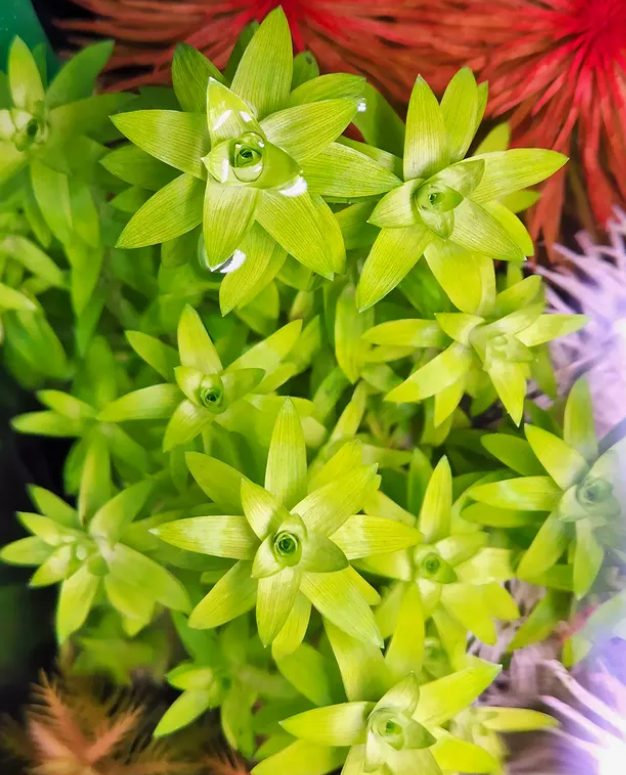
Image with text
Pair text with an image to focus on your chosen product, collection, or blog post. Add details on availability, style, or even provide a review.