
Aquapets ( KowloonAquarium)
Piptospatha Ridleyi
Piptospatha Ridleyi
Couldn't load pickup availability
Botanical Description
Piptospatha ridleyi is a small to medium-sized herb with a distinct appearance adapted to its riverside habitat .
-
General Habit: It is a rheophytic herb, meaning it thrives in fast-moving water, typically growing attached to rocks. It usually stands (8-)10-30(-40) cm tall and secures itself with a network of strong, extensive roots .
-
Stem (Shoot): The stem is condensed and short, only about 1-3 cm long, from which the leaves and inflorescence arise .
-
Leaves: The leaves are the most notable feature. They are narrowly elliptic in shape, measuring (4-)6-18(-23) cm long and (1-)2.5-6(-8) cm wide, with a leathery (coriaceous) texture . The petiole (leaf stalk) is often reddish and can be (3-)5-15(-18) cm long . A key characteristic is the leaf coloration: the upper side is dark green, usually (but not always) variegated with an irregularly spattered pattern of paler green spots, which has led to common names like "迷彩芋榕" (camouflage taro) .
-
Inflorescence (Flower): The flowering structure is typical of the aroid family .
-
It consists of a pinkish spathe (a modified leaf) that is broadly ovoid and about 2.5-3 cm long. The upper part of the spathe is deciduous (falls off) and is pink with darker veins and small dots .
-
Inside is the spadix (a fleshy spike), which is subcylindric-clavate (club-shaped) and about half the length of the spathe .
-
The spadix holds the flowers: a female zone at the base with whitish staminodes, and an upper male zone with truncate stamens .
-
-
Fruit and Seed: The fruiting spathe is broadly obconic (like an upside-down cone), about 1.5 cm wide, containing clustered berries. The seeds are small (1.5-1.8 mm long), brown, and have a long, curved, transparent micropylar appendage about 1.5 mm long, which links the seeds together in the fruit .
Distribution and Ecology
This species has a very specific native range and habitat .
-
Native Distribution: It is endemic to Malesia, specifically the Malay Peninsula. Its presence is primarily recorded in the state of Johor in Peninsular Malaysia, with a few collections also noted from the neighboring states of Pahang and Selangor .
-
Habitat and Ecology: As a rheophyte, it grows exclusively on rocks in and along streams and rivers. It is found in perhumid to moist forests at elevations ranging from 100 to 900 meters above sea level .
Cultivation Notes (for Aquarists and Hobbyists)
While the botanical information covers its wild form, Piptospatha ridleyi is also a sought-after plant in the aquarium trade . Here are some insights into its care, often shared by hobbyists:
-
Aquatic Use: It is considered a true aquatic plant that can be grown submerged. It is typically used as a mid-ground to background plant in aquascapes .
-
Growth: It has a medium growth rate and benefits from nutrient-rich substrates and supplemental CO2 for optimal health and faster growth .
-
Propagation: This is typically done by dividing clumps of the plant .
Materials
Materials
Shipping & Returns
Shipping & Returns
Dimensions
Dimensions
Care Instructions
Care Instructions
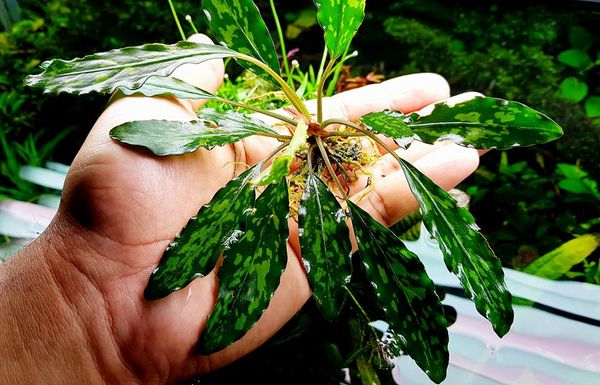
Image with text
Pair text with an image to focus on your chosen product, collection, or blog post. Add details on availability, style, or even provide a review.