
Aquapets ( KowloonAquarium)
Mayaca Fluviatilis
Mayaca Fluviatilis
Couldn't load pickup availability
Mayaca fluviatilis — Bog Moss, the Softest Texture in the Aquascape
Mayaca fluviatilis, commonly known as Bog Moss, is a uniquely textured stem plant native to the soft, acidic waterways of the southeastern United States, Central America, and South America. Despite its name, it is not a true moss — it’s a flowering vascular plant whose impossibly fine, needle-like leaves spiral densely around slender stems, creating a soft, furry, moss-like appearance that is unlike anything else in the planted tank hobby.
When trimmed regularly, it forms lush, cloud-like bushes that add an extraordinary layer of fine texture and depth to any aquascape. Its bright green, feathery mass provides stunning contrast against broad-leaved plants like Echinodorus or strap-leaved plants like Vallisneria — and doubles as perfect shelter for fry, shrimp, and small fish.
Appearance
- Height: Up to 60 cm (24 inches); typically kept trimmed as a midground or background bush
- Leaves: Extremely fine, needle-like, spiral-alternate; bright to yellowish-green with a soft, moss-like texture
- Growth habit: Upright to creeping stem plant; branches freely when trimmed, forming dense, fluffy bushes
Care & Planting Tips
- Plant in groups and trim frequently — regular cutting encourages dense, bushy branching
- Replant trimmed tops to propagate and fill in gaps quickly
- Column feeder — absorbs nutrients primarily through stems and leaves; regular liquid fertilization is essential
- Iron is critical — yellowing or white new leaves are a classic sign of iron deficiency; increase trace/micronutrient dosing to correct
- CO₂ supplementation promotes denser, lusher growth and prevents stunting
Ideal Tank Parameters
- pH: 5.5 – 7.0 (prefers soft, slightly acidic water)
- Temperature: 20 – 28°C (68 – 82°F)
- Hardness: Soft preferred
- Lighting: Medium to High
- CO₂: Strongly recommended
- Fertilization: Regular liquid fertilizer with iron and macronutrients — essential for healthy growth
Sold as a stem cutting. Note: this plant is often confused with Java Moss due to its common name, but it is a true flowering plant requiring substrate planting. Not a true moss.
Materials
Materials
Shipping & Returns
Shipping & Returns
Dimensions
Dimensions
Care Instructions
Care Instructions
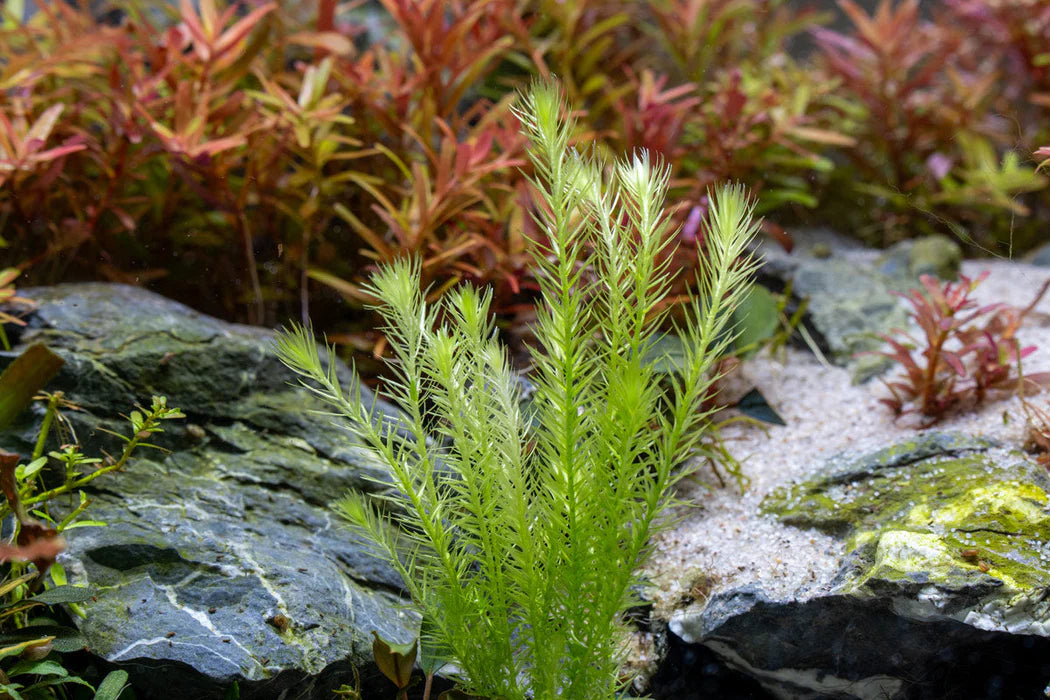
Image with text
Pair text with an image to focus on your chosen product, collection, or blog post. Add details on availability, style, or even provide a review.