
Aquapets ( KowloonAquarium)
Ludwigia Ovalis
Ludwigia Ovalis
Couldn't load pickup availability
Overview
Ludwigia ovalis, commonly known as Oval-leaf Seedbox, is a species of flowering plant in the Onagraceae family . It's a perennial herb known for its creeping growth habit and is native to East Asia . It has gained popularity as an ornamental plant for ponds and aquariums due to its attractive foliage .
Here is a quick overview of its key characteristics:
Botanical Description
Growth Form and Habitat
Ludwigia ovalis is a delicate, perennial herb . Its stems are decumbent or creeping, growing along the ground and rooting at the nodes (joints), which allows it to form dense mats . The stems can grow up to 50 cm long, with the tips ascending upwards . In its natural habitat, it is found in moist, open areas such as the edges of ponds, lakes, streams, and rice paddies, from lowlands up to an altitude of about 500 meters .
Leaves
The leaves are one of its most distinctive features. They are:
-
Size: Small, typically 0.5 to 2.5 cm long and 0.4 to 2 cm wide .
-
Arrangement: The leaves are arranged alternately on the stem . This is a key characteristic that distinguishes it from some similar Ludwigia species, like L. repens, which have opposite leaves .
-
Other features: They are smooth and hairless (glabrous) with a pointed tip (acute apex). The base of the leaf narrows abruptly into a short, winged petiole (leaf stalk) .
Flowers
The flowers of L. ovalis are small and easily overlooked, as they lack petals .
-
Arrangement: They grow singly in the leaf axils (the angle between the leaf and the stem) on the upper parts of the plant .
-
Structure: They have four green, triangle-shaped sepals that are 1-3 mm long . The most notable feature is the complete absence of petals .
-
Reproductive parts: The flower has 4 stamens with pale yellow anthers. The style is green and topped with a prominent, globe-shaped, dark green stigma .
-
Blooming Season: In its native range, it typically flowers from July to September .
Fruits and Seeds
The fruit is a small, oblong capsule that is 3-5 mm long and has four angles or wings . It is finely hairy and contains many tiny seeds . The seeds are reddish-brown, elliptical, and have a textured surface with lengthwise and crosswise ridges .
Distribution and Habitat
Ludwigia ovalis is native to East Asia. Its native range includes:
It thrives in wet, open habitats such as the shores of lakes and ponds, marshes, ditches, and other consistently moist places .
Uses and Significance
Ornamental Use
Ludwigia ovalis is highly valued in aquascaping and water gardening .
-
Aesthetics: Its small, oval leaves can develop beautiful shades of pink, orange, or red, especially under strong lighting in an aquarium or in full sun .
-
Aquariums: Its low-growing, creeping habit makes it an excellent choice for the mid-ground or foreground of planted aquariums . It is considered relatively easy to grow, with moderate lighting and nutrient supplementation (especially iron) helping to enhance its vibrant colors .
-
Ponds: It can be planted in the shallow margins of ponds, where it forms attractive mats of foliage .
Medicinal Uses
In traditional medicine, particularly in China, the whole plant is used for its "heat-clearing and diuretic" properties, and is said to be helpful for conditions like jaundice and dysentery . The leaves can also be mashed into a poultice and applied to wounds to help stop bleeding
Materials
Materials
Shipping & Returns
Shipping & Returns
Dimensions
Dimensions
Care Instructions
Care Instructions
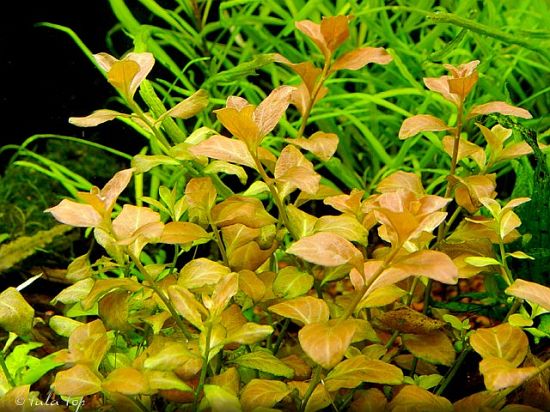
Image with text
Pair text with an image to focus on your chosen product, collection, or blog post. Add details on availability, style, or even provide a review.