
Aquapets ( KowloonAquarium)
Ludwigia Arcuata
Ludwigia Arcuata
Couldn't load pickup availability
Overview and Taxonomy
Ludwigia arcuata is a species of flowering plant in the evening primrose family (Onagraceae) . It was first formally described by Thomas Walter in his 1788 publication, Flora Caroliniana .
-
Common Names: It is widely known as Piedmont primrose-willow in its native range . In the aquarium trade, it is frequently called Narrow Leaf Ludwigia or Needle Leaf Ludwigia due to its fine foliage . One source also mentions the name "Small Red Berry" .
-
Synonyms: Over time, it has been reclassified, with homotypic synonyms including Isnardia arcuata and Ludwigiantha arcuata .
Physical Description
This plant is a perennial herb that displays different growth forms depending on its environment .
-
Growth Habit: It can be prostrate and creeping (growing along the ground and rooting at its nodes), often forming mats, or decumbent to ascending (lying on the ground but with upright tips) . When grown underwater in an aquarium, it adopts a more upright, ascending growth habit .
-
Stems: The slender, reddish stems are slightly ridged, well-branched, and can reach 5-70 cm (about 2-27.5 inches) in length, growing up to 50 cm or more in aquatic settings .
-
Leaves: The leaves are one of its most distinctive features. They are opposite, simple, and can be lanceolate (lance-shaped) to very narrowly linear (needle-like) .
-
Emerged/Emersed Leaves: On stems growing out of the water, leaves are typically narrowly elliptic to linear, measuring 0.6-1.8 cm long and 0.2-0.5 cm wide .
-
Submersed Leaves: When grown underwater, the leaves become longer and narrower, reaching 1.9-4 cm in length but only 0.1-0.25 cm wide, which gives the plant its "needle leaf" appearance .
-
Color: The foliage color is highly variable. It is generally green but can turn beautiful shades of yellow, orange, or brick red to red-brown under strong lighting, especially in submersed forms .
-
-
Flowers: The plant produces showy, bright yellow flowers on emergent stems .
-
They are formed in the leaf axils (where the leaf meets the stem) and have four yellow petals (7-11 mm long) and four small, pointed green sepals .
-
The flowers are among the largest in its section and are primarily outcrossing, attracting insect visitors .
-
The flowering period is typically from spring to late summer (March to September) .
-
-
Fruits and Seeds: The fruit is a hard-walled, club-shaped (clavate) capsule (5.5-10 mm long) that contains numerous small seeds .
Native Habitat and Distribution
-
Native Range: As confirmed by multiple authoritative sources, Ludwigia arcuata is native to the southeastern United States .
-
Detailed Distribution: Its native range is primarily in the coastal plains, specifically in the states of Alabama, Florida, Georgia, and South Carolina .
-
Habitat: In the wild, it is found in wet, sunny areas such as roadside ditches, edges of lakes and ponds, swampy prairies, springs, and sandy or mucky shorelines . It thrives in shallow, still or slow-moving water .
Cultivation and Uses
Ludwigia arcuata is highly prized in the aquarium hobby and for water gardens due to its fine texture and vibrant colors .
-
Aquarium Trade: It is a popular stem plant for aquascaping, where its needle-like leaves provide contrast against broader-leaved plants .
-
Color Requirements: To achieve the intense red coloration that makes it so desirable, the plant requires high levels of lighting . In lower light, it will remain green. Nutrient levels, particularly low nitrogen and adequate iron and phosphorus, also influence the shift from green to red .
-
Growth Conditions: It has a moderate growth rate and is considered relatively easy to care for with the right conditions .
-
Light: Prefers moderate to high light. Full sun is ideal for emersed growth .
-
Water: Temperature should be maintained between 20-28°C (68-82°F) , with a pH of 5.5-8.0 .
-
Substrate: Benefits from a nutrient-rich substrate to support root feeding .
-
CO2: While not strictly necessary, CO2 injection can significantly improve growth and color, especially in high-light setups .
-
-
Propagation: It is very easy to propagate. Simply take a stem cutting from a healthy plant and replant it in the substrate. Roots typically develop within 2-4 weeks .
-
Pruning: Regular pruning (every 4-6 weeks) by cutting the tops of stems encourages the plant to bush out, creating a fuller appearance .
Materials
Materials
Shipping & Returns
Shipping & Returns
Dimensions
Dimensions
Care Instructions
Care Instructions
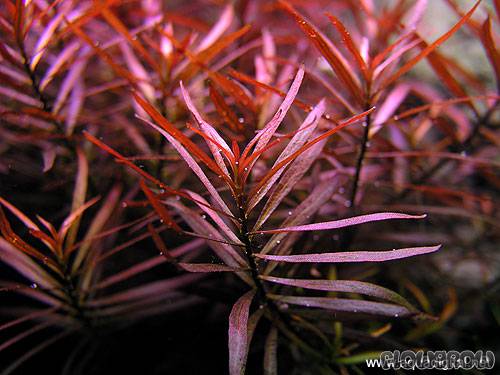
Image with text
Pair text with an image to focus on your chosen product, collection, or blog post. Add details on availability, style, or even provide a review.