
Aquapets ( KowloonAquarium)
Least Rasbora (Boraras Urophthalmoides)
Least Rasbora (Boraras Urophthalmoides)
Couldn't load pickup availability
Boraras urophthalmoides, commonly known as the Least Rasbora or Exclamation Point Rasbora, is a very small, peaceful, and visually striking freshwater fish native to Southeast Asia . It is a popular choice for nano and planted aquariums .
Here is a detailed overview of this species, covering its scientific classification, appearance, natural habitat, and care requirements.
Scientific Classification & Names
-
Common Names: Least Rasbora, Exclamation Point Rasbora, 蚂蚁灯鱼 (Chinese: "Ant Light Fish"), Red Ants Lamprey
-
Family: Danionidae (subfamily Rasborinae), formerly classified under Cyprinidae
-
Etymology: The species name comes from urophthalmus (Greek for "tail" and "eye", referring to the tail spot) and -oides (Greek for "likeness") .
Physical Appearance & Size
-
Size: This is a miniature fish species. While scientific records note a maximum total length of up to 4.0 cm , in aquarium settings and according to hobbyist sources, they are often reported to be smaller, around 2 cm .
-
Coloration: The body is predominantly reddish, featuring a prominent black or dark brown lateral stripe that runs from the snout, through the eye, to the base of the tail . Above this dark stripe, there is a lighter, sometimes slightly iridescent, stripe . Additional dark spots are present at the base of the caudal fin (tail) and the anal fin .
-
Similar Species: It is very similar to its relative, Boraras brigittae (Chili Rasbora), but generally has a less intense, bright red coloration .
Natural Habitat & Distribution
-
Geographic Range: The species is widely distributed in mainland Southeast Asia. Its native range includes Thailand, Cambodia, Vietnam, Peninsular Malaysia, and the lower parts of the Mekong and Chao Phraya basins .
-
Habitat: In the wild, Boraras urophthalmoides inhabits slow-moving or stagnant freshwater environments like marshes, swamps, peatlands, and ponds . These waters are typically characterized by dense growth of fine-leaved aquatic plants and are often stained brown by tannins from decaying organic matter .
Aquarium Care & Husbandry
This species is well-suited for peaceful community tanks, particularly nano aquariums.
Reproduction (Breeding)
-
Difficulty: Breeding is considered very difficult in a home aquarium .
-
Method: They are egg-scatterers. Spawning is triggered by soft, acidic water and warmer temperatures (up to 28°C) .
-
Behavior: Adults will eat their own eggs and fry, so they must be removed from the breeding tank immediately after spawning . Eggs are typically laid among fine-leaved plants like Java moss .
-
Fry Care: The fry are extremely tiny and require infusoria or other microscopic foods for the first few days .
Conservation & Human Use
-
IUCN Red List Status: Near Threatened (NT) . The primary threats are habitat loss due to the development of wetlands for agriculture and logging, as well as harvesting for use as food fish in aquaculture .
-
Human Use: While it is a commercial species in the aquarium trade , it is more extensively used as a live food source for larger farmed fish in parts of its range, such as southern Vietnam and Thailand .
Materials
Materials
Shipping & Returns
Shipping & Returns
Dimensions
Dimensions
Care Instructions
Care Instructions
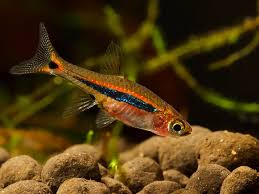
Image with text
Pair text with an image to focus on your chosen product, collection, or blog post. Add details on availability, style, or even provide a review.