
Aquapets ( KowloonAquarium)
Echinodorus amazonicus (Amazon Sword)
Echinodorus amazonicus (Amazon Sword)
Couldn't load pickup availability
Taxonomy and Name
There is a bit of scientific debate surrounding its exact name.
-
Scientific Name: While widely sold as Echinodorus amazonicus, it is often considered a synonym or variety of Echinodorus grisebachii by many botanists . You may also see it labeled as Echinodorus grisebachii 'Amazonicus' .
-
Origin: Native to South America, particularly the Amazon River basin in Brazil .
Physical Description
The Amazon Sword is a rosette-type plant, meaning its leaves grow from a central crown.
-
Leaves: It features long, lanceolate (spear-shaped) to narrowly oval leaves that are a vibrant, bright green . The leaves have a prominent central vein and grow from a short, compact stem or crown . The classic E. amazonicus variety has relatively long, narrow, pointed leaves compared to broader-leaved relatives like Echinodorus bleheri .
-
Size: This is a large plant. In an aquarium, it typically reaches a height of 30 to 50 cm (12 to 20 inches) . The leaves can be 2-3 cm wide .
-
Growth Habit: It grows vertically from a central root system, making it an excellent background or midground focal point .
Aquarium Care and Requirements
The Amazon Sword is renowned for being an easy plant to care for, making it suitable for beginners . However, to help it thrive and reach its full potential, specific conditions are recommended.
Propagation
Propagating Amazon Swords is straightforward and primarily happens through two methods:
-
Runners: The most common method in aquariums. The mature plant will send out long stems (runners) horizontally across the substrate. Small plantlets will develop at intervals along these runners. Once the plantlets have developed a good root system and a few leaves, they can be cut from the mother plant and replanted elsewhere .
-
Adventitious Plantlets: The plant may also produce flower stalks that grow above the water. Small plantlets can form on these stalks, which can then be removed and planted .
Aquarium Mates and Compatibility
The Amazon Sword's large, broad leaves provide excellent cover and shelter for fish, especially shy species or fry .
-
Good Companions: It is compatible with most peaceful community fish such as Tetras, Angelfish, Discus, Guppies, Mollies, Gouramis, and Corydoras catfish. It also does well with shrimp and snails .
-
Species to Avoid: Avoid housing it with large, herbivorous fish that are likely to nibble on and damage the leaves. This includes Goldfish, Silver Dollars, large Cichlids, and most Plecos
Materials
Materials
Shipping & Returns
Shipping & Returns
Dimensions
Dimensions
Care Instructions
Care Instructions
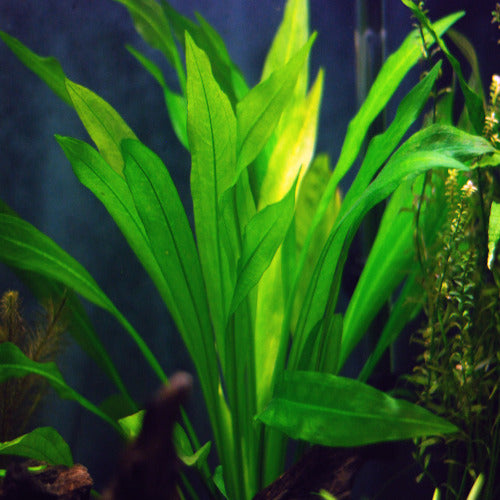
Image with text
Pair text with an image to focus on your chosen product, collection, or blog post. Add details on availability, style, or even provide a review.