
Aquapets ( KowloonAquarium)
Betta Hendra (Pair)
Betta Hendra (Pair)
Couldn't load pickup availability
Betta Hendra — A Rare Wild Betta from the Blackwaters of Borneo
Exquisite, rare, and deeply sought-after by wild betta enthusiasts, Betta hendra is a stunning small wild betta species endemic to the blackwater peat swamp forests of Central Kalimantan, Borneo. Named in honour of aquarist Hendra Kottelat, this jewel-like species displays an iridescent blue-green body with rich red-brown banding and vivid fin colouration — a combination of colours that rivals even the most elaborate captive-bred bettas, yet retains the wild elegance that makes this species so prized among collectors.
Unlike the common Siamese Fighting Fish, Betta hendra is a peaceful, mouthbrooding species that can be kept as a pair — making it a fascinating and rewarding fish for the dedicated blackwater specialist. Sold as a bonded pair (male + female).
Care at a Glance
- Common Name: Betta Hendra
- Scientific Name: Betta hendra
- Origin: Central Kalimantan, Borneo (blackwater peat swamp forests)
- Adult Size: Up to 4 cm (1.5 inches)
- pH: 6.5 – 7.2 (soft, acidic blackwater preferred)
- General Hardness (GH): 3 – 10
- Carbonate Hardness (KH): 1 – 2
- TDS: 100 – 300
- Temperature: 18 – 25°C (64 – 78°F)
- Temperament: Peaceful; can be kept as a pair
- Breeding Type: Paternal mouthbrooder
- Difficulty: Moderate to Advanced
Tank & Setup Tips
Betta hendra thrives in a blackwater biotope setup — soft, acidic, tannin-rich water replicating the peat swamp forests of Borneo. Use Indian almond leaves, driftwood, and leaf litter to naturally acidify the water and create the dark, tea-coloured environment this species is adapted to. Dim lighting and dense surface cover (floating plants) are essential for their comfort and security.
A small, well-established tank of 10–20 gallons is ideal for a pair. Gentle filtration with minimal flow is critical — they come from still or very slow-moving waters. Keep the tank tightly covered as bettas are skilled jumpers.
Feeding
Carnivorous micro predators. Prefer live and frozen small foods: baby brine shrimp, micro worms, daphnia, and small frozen bloodworms. May be reluctant to accept dry foods initially — live foods are strongly recommended to condition them and encourage breeding behaviour. Feed small amounts 2–3 times daily.
Compatible Tank Mates
Best kept as a species-only pair or in a carefully chosen blackwater community with very small, non-competitive species. Suitable companions include small rasboras (chili, exclamation point), small pencilfish, and pygmy corydoras. Avoid any fish large enough to intimidate or outcompete them for food.
Breeding
Betta hendra is a paternal mouthbrooder — after spawning, the male collects and incubates the eggs in his mouth for approximately 10–14 days until the fry are released as free-swimming juveniles. Breeding pairs should be well-conditioned on live foods beforehand. Fry are tiny and require infusoria or commercial fry foods initially before graduating to baby brine shrimp.
📸 Photos are for reference only. Actual fish may vary slightly in colour and pattern — each one is uniquely beautiful!
Materials
Materials
Shipping & Returns
Shipping & Returns
Dimensions
Dimensions
Care Instructions
Care Instructions
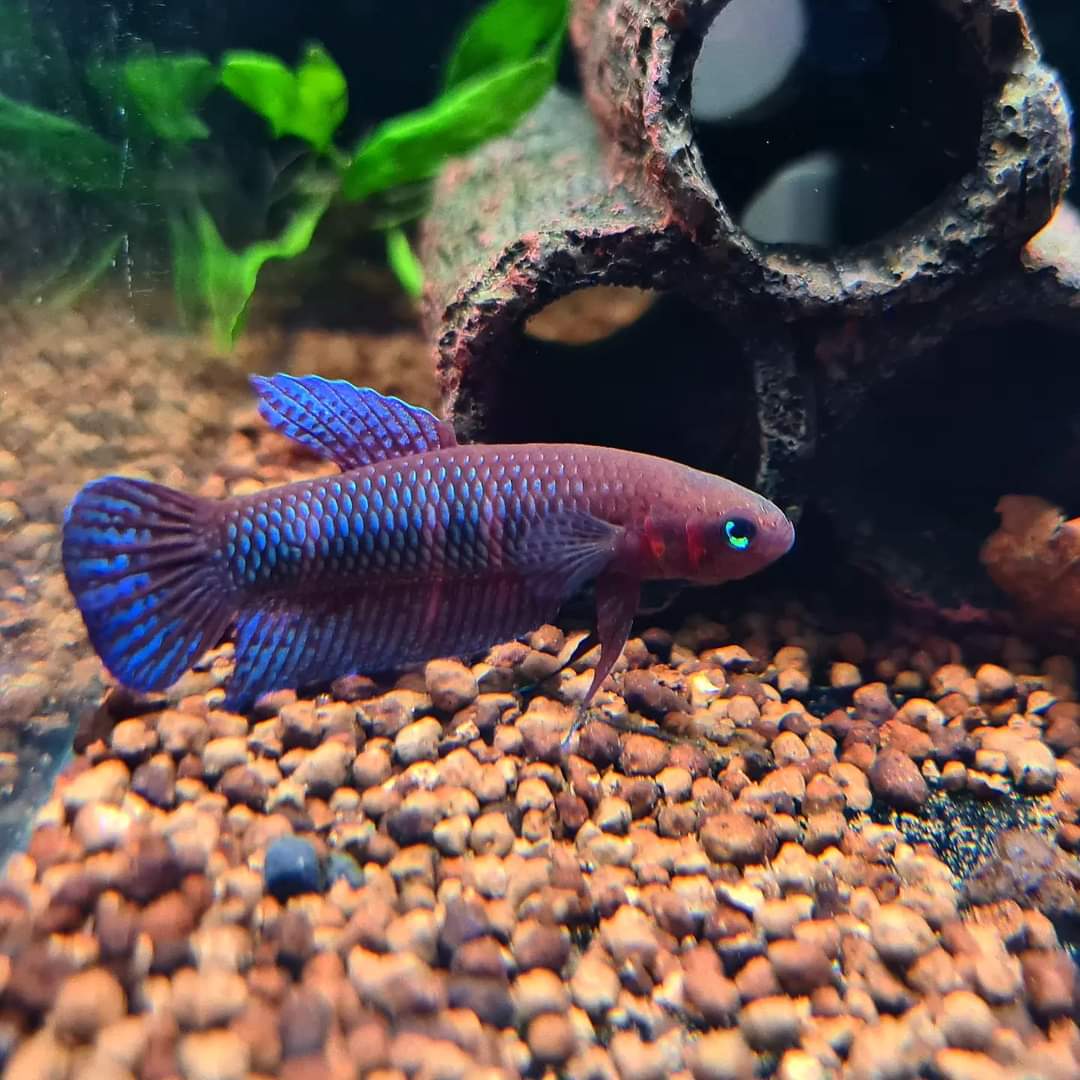
Image with text
Pair text with an image to focus on your chosen product, collection, or blog post. Add details on availability, style, or even provide a review.