
Aquapets ( KowloonAquarium)
White Amano Shrimp (Caridina Multidentata)
White Amano Shrimp (Caridina Multidentata)
Couldn't load pickup availability
The "White Amano Shrimp" is a stunning, selectively bred color variant of the standard Amano Shrimp (Caridina multidentata). It is highly prized in the aquarium trade for its elegant, snowy-white appearance and its famous, tireless appetite for algae.
Here are the key details you need to know about this unique shrimp.
What is a White Amano Shrimp?
The White Amano Shrimp is a color morph developed through selective breeding, primarily originating from Taiwan. Unlike the standard wild-type Amano, which is a transparent greenish-brown, this variant displays a striking, uniform opaque white to translucent white coloration . This variety is often sold under names like "Snow Amano" or "Snow White Amano Shrimp."
It is believed to be a stable, permanent mutation, meaning it will not revert to the wild coloration over time as some earlier, less stable white varieties did .
Origin and Natural Habitat
While the white variant is captive-bred, the species Caridina multidentata originates from freshwater streams and rivers in Japan, Taiwan, Korea, and Madagascar . In the wild, they inhabit flowing waters that eventually lead to the sea, a critical factor for their unique breeding process .
👀 Physical Appearance and Size
Ideal Aquarium Care
Diet and Feeding
White Amano Shrimp are omnivorous scavengers and are not picky eaters. In the aquarium, they will constantly graze on:
-
Algae: They are famous for eating many types of algae, including troublesome hair algae and biofilm .
-
Supplemental Foods: Algae wafers, shrimp pellets, blanched vegetables (like zucchini or spinach), and occasional protein-rich foods (like bloodworms or brine shrimp) .
-
Important Note: While excellent at controlling algae, they cannot survive on it alone and require a balanced diet .
Behavior and Tank Mates
These shrimp are completely peaceful and highly active, constantly searching for food . They are best kept in groups of 5 or more, which makes them feel more secure and display more natural behavior .
Good tank mates include small, non-aggressive fish like tetras, rasboras, guppies, and other peaceful invertebrates like snails or smaller dwarf shrimp (e.g., Neocaridina). Avoid housing them with large or predatory fish such as cichlids or puffers .
The Challenge of Breeding
Breeding White Amano Shrimp in a home aquarium is considered very difficult for a specific reason: their larvae require brackish (salty) water to survive .
-
Females will carry up to 2000 tiny eggs for about 4-6 weeks before releasing larvae into the freshwater .
-
The minuscule larvae will only survive in freshwater for a few days .
-
To raise them, a breeder must transfer the larvae to a separate tank with saltwater (marine salinity) and feed them microscopic foods like phytoplankton for several weeks until they metamorphose into baby shrimp. They must then be slowly acclimated back to freshwater .
Due to this complex life cycle, the vast majority of White Amano Shrimp sold in stores are wild-caught or commercially raised.
Quick Tips for Success
-
Acclimate Slowly: Like all shrimp, they are sensitive to sudden changes in water parameters. Use a drip acclimation method when introducing them to a new tank .
-
Avoid Copper: Never use copper-based medications in a tank with shrimp, as copper is highly toxic to them .
-
Provide Hiding Places: Ensure plenty of cover, especially after they molt (shed their exoskeleton), as they are vulnerable until their new shell hardens .
Materials
Materials
Shipping & Returns
Shipping & Returns
Dimensions
Dimensions
Care Instructions
Care Instructions
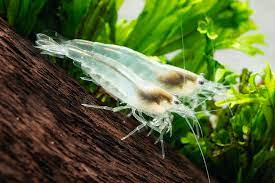
Image with text
Pair text with an image to focus on your chosen product, collection, or blog post. Add details on availability, style, or even provide a review.