
Aquapets ( KowloonAquarium)
German Rams (Mikrogeophagus Ramirezi)
German Rams (Mikrogeophagus Ramirezi)
Couldn't load pickup availability
The Ram cichlid (Mikrogeophagus ramirezi) is a small, brilliantly colored freshwater fish and one of the most popular "dwarf cichlids" in the aquarium hobby . Known for its peaceful demeanor and striking appearance, it's a jewel of a fish that requires specific care to thrive .
Here are some key details about this species.
Scientific Name & Origin
The Ram cichlid has a bit of a tangled taxonomic history. It was first described in 1948 as Apistogramma ramirezi . Since then, it has been placed in several different genera, including Papiliochromis and the often-misspelled Microgeophagus. Today, the scientifically accepted name is Mikrogeophagus ramirezi .
The name itself is quite descriptive:
-
Mikrogeophagus comes from the Greek mikros (small), gea (earth), and phagein (to eat), together meaning "small earth-eater," which refers to its feeding behavior .
-
ramirezi is in honor of Manuel Vicente Ramirez, a Venezuelan collector who is credited with discovering and importing the species .
Natural Habitat
Contrary to popular belief, the Ram cichlid does not come from the main channel of the Amazon River. Its native home is the warm, acidic, and mineral-poor waters of the Orinoco River basin in the Llanos of Venezuela and Colombia . The Llanos is a vast tropical savanna with slow-moving streams and seasonally flooded plains .
Appearance
The Ram cichlid is renowned for its dazzling colors.
-
Wild-Type Appearance: The body is typically a golden-yellow to peach color on the head, fading to an iridescent blue or blue-green on the flanks and fins . A prominent black spot, often ringed in iridescent blue, is located in the middle of the body, and a vertical black stripe runs through the bright red eye .
-
Sexual Dimorphism: Telling males and females apart requires a close look.
-
Males are generally slightly larger (up to 5-7 cm) and have more pointed dorsal and anal fins, with the first few rays of the dorsal fin extended into a filament .
-
Females are smaller, have a rounded dorsal fin, and develop a distinctive bright pink or red blush on their belly, especially when ready to spawn .
-
-
Selectively Bred Varieties: Years of selective breeding have produced stunning color morphs, though they can sometimes be more delicate or have reduced fertility. Popular varieties include:
Aquarium Care
While not a fish for beginners, the Ram cichlid is manageable for hobbyists willing to meet its needs. The key is stability and excellent water quality .
Behavior & Tank Mates
Rams are peaceful and social fish that are best kept in established pairs . They form strong pair bonds and will defend a small territory during breeding, but their aggression is usually limited to chasing, not harming, other fish . They primarily inhabit the middle and lower levels of the aquarium .
Excellent tank mates include other peaceful species that also prefer warm, soft water:
-
Small tetras (like Neon, Cardinal, or Rummy Nose Tetras)
-
Peaceful catfish (like Corydoras or Otocinclus)
-
Danios
-
Dwarf cichlids (like Apistogramma species)
-
Even larger, peaceful cichlids like Discus or Angelfish can be good companions .
Avoid keeping them with large, aggressive, or boisterous fish that will outcompete them for food or stress them .
Breeding
Breeding Rams can be a rewarding experience. They are open (substrate) spawners, typically laying their eggs on a flat stone or in a small pit in the substrate .
-
Both parents will participate in brood care, fanning the eggs and defending the territory.
-
The eggs usually hatch in about 60 hours, with the fry becoming free-swimming after another 3-5 days .
-
The fry are very tiny and will initially require infusoria or microworms before graduating to baby brine shrimp . One challenge is that parent Rams are known to sometimes eat their own eggs or fry, especially if disturbed .
Sourcing Healthy Fish
Because they are so popular, many Rams are mass-produced on commercial farms. Unfortunately, these fish can sometimes be weak, inbred, or treated with hormones to enhance color, which can lead to health and fertility problems . Whenever possible, try to find fish from reputable local breeders or sources known for high-quality stock, as these are often hardier .
Materials
Materials
Shipping & Returns
Shipping & Returns
Dimensions
Dimensions
Care Instructions
Care Instructions
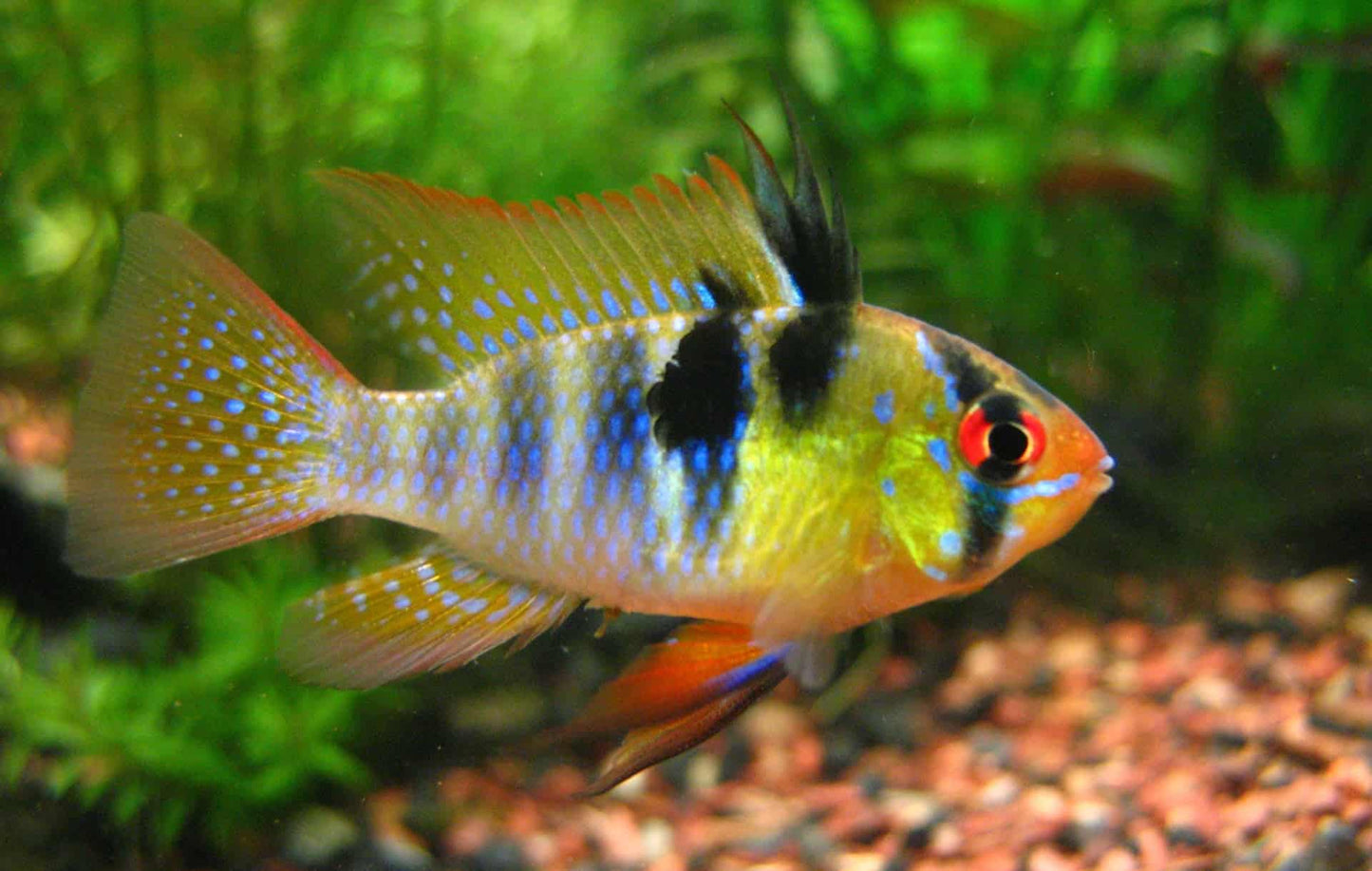
Image with text
Pair text with an image to focus on your chosen product, collection, or blog post. Add details on availability, style, or even provide a review.