
Aquapets ( KowloonAquarium)
Anubias Nana sp. Petite
Anubias Nana sp. Petite
Couldn't load pickup availability
Quick Reference Table
| Aspect | Details |
|---|---|
| Scientific Name | Anubias barteri var. nana 'Petite' (often a trade name, not a formal botanical variety) |
| Common Names | Anubias Nana Petite, Dwarf Anubias Petite |
| Origin | Cultivar (laboratory/propagation origin), originally derived from West Africa. |
| Plant Type | Epiphyte (grows attached to hardscape, not in substrate). |
| Growth Speed | Extremely Slow. New leaves may take weeks. |
| Difficulty | Very Easy - Ideal for beginners. |
| Lighting | Low to Medium. Thrives in shade, suffers in high light (algae). |
| CO2 | Not required, but can benefit from it. |
| Placement | Foreground & Midground (as a small accent on rocks/wood). |
In-Depth Details
1. Appearance & Characteristics
-
Size: This is the smallest commercially available Anubias. Individual leaves are typically 0.5 to 1.5 inches (1.3 - 4 cm) long. The entire plant usually stays under 3-5 inches tall and wide, forming a dense, compact clump.
-
Leaves: Dark green, thick, waxy, and very hardy. The shape is classic Anubias: a broad, rounded base (cordate) tapering to a point. The leaf texture is slightly bumpy.
-
Rhizome: This is the key to its success. The rhizome is a horizontal, stem-like structure from which leaves and roots grow. It must never be buried, as it will rot. The roots can be anchored into crevices or attached to surfaces.
2. Tank Requirements & Care
-
Water Parameters: Highly adaptable. Prefers:
-
Temperature: 72° - 82° F (22° - 28° C)
-
pH: 6.0 - 7.5
-
Hardness: Soft to moderately hard water is fine. It's not picky.
-
-
Planting/Attachment:
-
DO NOT PLANT IN SUBSTRATE. This is the most common mistake.
-
Attach it to driftwood, rocks, or aquarium decorations using:
-
Cotton thread (will decay over time, by then roots have attached).
-
Fishing line (clear and durable).
-
Super Glue (Cyanoacrylate Gel): The preferred method. A tiny dab on the rhizome, press to a dry surface for 10 seconds, and it's set. It's completely aquarium-safe once cured.
-
-
-
Fertilization: While it can survive on water column nutrients from fish waste, it will grow more vigorously and produce darker leaves with a comprehensive liquid fertilizer containing macro and micro-nutrients. Root tabs are unnecessary as it's not a root-feeder.
-
Maintenance: Minimal. Simply remove any old, yellowing leaves by cutting the stem close to the rhizome. Algae can be gently wiped off the tough leaves.
3. Propagation
Propagation is simple but requires patience due to slow growth.
-
Identify a healthy, mature rhizome with several leaves.
-
Using sharp, clean scissors, cut the rhizome into pieces, ensuring each piece has at least 2-3 healthy leaves.
-
Attach the new piece to a new location. A new growth point will eventually form from the cut end.
4. Common Problems & Solutions
-
Yellowing Leaves: Usually a sign of nutrient deficiency (often nitrogen or potassium). Start dosing a liquid fertilizer.
-
Melting/Transparent Leaves: Rare, but can happen if moved from emersed (nursery) to submerged form. The plant is adjusting. Remove the melting leaf; new submerged-growth leaves will follow.
-
Algae on Leaves: The #1 issue. Caused by too much light and/or nutrient imbalance. Move the plant to a shadier spot, reduce photoperiod, ensure good water flow, and introduce algae-eating livestock like Amano shrimp or Nerite snails.
-
Rhizome Rot: If the rhizome turns mushy and brown. Caused by being buried or damaged. Cut away all rotted portions immediately until only firm, green rhizome remains. Re-attach the healthy part.
5. Aquascaping Uses
-
Foreground Accent: Perfect for creating tiny "bushes" at the base of hardscape.
-
Iwagumi Stones: The classic use—attached to the contact points between stones to simulate ancient, weathered growth.
-
Wood Detail: Attached to branches of driftwood to create a "tree" or "bonsai" effect.
-
Filler & Texture: Adds crucial dark green, textured contrast to fine-leaved plants or bright carpets.
Materials
Materials
Shipping & Returns
Shipping & Returns
Dimensions
Dimensions
Care Instructions
Care Instructions
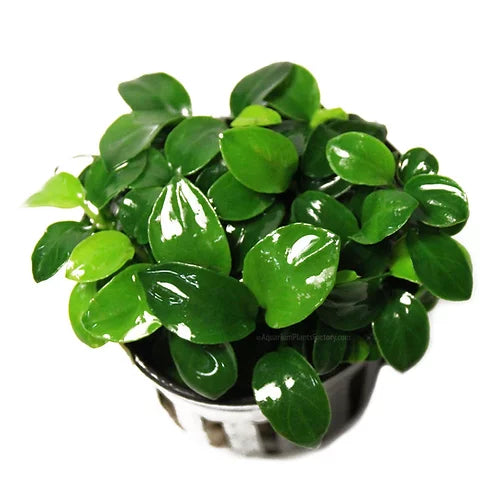
Image with text
Pair text with an image to focus on your chosen product, collection, or blog post. Add details on availability, style, or even provide a review.